

NDIS Provider Travel and Kilometre Charges Explained
What a provider can charge for travelling to you and for driving you, the limits on each, the item codes, and how to check an invoice.
 By Anupa Bhetwal, Registered Nurse · Funding · 9 min read · last checked 10 November 2026
In short
- A provider can charge travel time to reach you: up to 30 minutes in Sydney and other MMM1 to 3 areas.
- The worker's own kilometres are capped at $0.99 a km. Tolls and parking can be charged at cost.
- Driving you during a support is activity-based transport: up to $0.99 a km, or $2.76 in a modified vehicle or bus.
- Therapists claim travel time at half their hourly rate.
- None of these charges come out of your recurring transport funding.
Travel is the part of an NDIS invoice people query most. The rules are set by the NDIA, and they are the same for every provider. This guide sets them out with the item codes, worked examples and a checklist for your invoices.
What changed in 2026-27, and what did not
Since 24 September 2026, maximum prices have been set by the Minister in the NDIS Pricing Schedule 2026-27. The hourly rate for a support worker on a weekday rose to $73.58.
The travel rules did not change. The NDIA says it will publish updated claiming guidance shortly. Until it does, the rules are in the Pricing Arrangements and Price Limits 2025-26.
The last real change was for therapists. From 1 July 2025, therapy travel time is claimed at half the therapy rate, as the NDIA explained in its travel claiming news item.
The three travel charges
A provider can charge for three different things. Each has its own limit.
| Charge | What it is | Limit |
|---|---|---|
| Travel time | The worker's time getting to you | Up to 30 minutes in MMM1 to 3 areas, 60 minutes in MMM4 to 5, at the support's hourly rate or lower |
| Travel kilometres | The cost of the worker's car getting to you | Up to $0.99 a km, plus tolls and parking at cost |
| Activity-based transport | The kilometres while the worker drives you during a support | Up to $0.99 a km in a standard car, or $2.76 in a modified vehicle or bus |
All three are claimed from the budget for the support itself. None comes out of the transport money paid to you.
Travel time: the 30-minute cap
A provider can claim up to 30 minutes of travel to reach you in MMM1 to 3 areas. In MMM4 to 5 areas the cap is 60 minutes, and remote areas have no cap.
MMM stands for the Modified Monash Model, which sorts places by remoteness. All of Western Sydney is MMM1, a major city, so the 30-minute cap applies here.
Travel back to the office can be claimed too, but only from the worker's last participant of the trip, and only if the provider must pay the worker for it. The time is charged at the support's hourly rate, or lower if you agree.
Three conditions apply. The travel must be agreed with you in advance, the support must be face to face, and the provider must pay the worker for travel time.
Kilometres: $0.99 a km
The worker's kilometres to reach you are capped at $0.99 a km, whoever owns the car. Tolls, parking and public transport fares can be charged at the full cost.
The higher $2.76 rate does not apply to a worker's own travel. It is only for activity-based transport in a modified vehicle or bus.
Activity-based transport
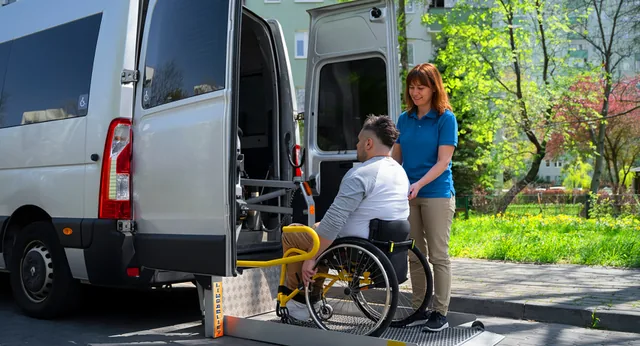
When a worker drives you during a support, for example to an activity or the shops, the kilometres are activity-based transport. The limit is $0.99 a km in a standard car, or $2.76 a km in a vehicle modified for accessibility or a bus.
The worker's time while driving is billed on the support item itself. If two people share the trip, the kilometres are split between them.
Which item codes are used?
Travel kilometres and activity-based transport are claimed at $1.00 a unit, so 18 km at $0.99 is claimed as 17.82 units. The codes depend on the support.
| Code | What it is for |
|---|---|
| 01_799_0107_1_1 | Provider travel kilometres for daily personal activities |
| 04_799_0125_6_1 | Provider travel kilometres for community participation |
| 04_799_0136_6_1 | Provider travel kilometres for group and centre activities |
| 04_590_0125_6_1 | Activity-based transport for community participation |
| 04_591_0136_6_1 | Activity-based transport for group and centre activities |
| 04_592_0104_6_1 | Activity-based transport with high intensity support |
Travel time has no code of its own. It is claimed on the same item as the support, at its hourly rate.
Therapy travel is charged at half rate
From 1 July 2025, therapists claim travel time at half their hourly rate. An occupational therapist charging $193.99 an hour can claim travel at up to $97.00 an hour.
The 2026-27 schedule gives therapy travel its own items, which end in "_PT". The time caps are the same as for support workers.
Shared trips, groups and cancellations
- Shared trips. If a worker visits two participants on the same trip, the travel time and kilometres are divided between them.
- Groups. In a group support, the price is divided by the number of people, and so is shared transport.
- Cancellations. Short-notice cancellation is a separate rule from travel. Ask what notice the provider needs, and get it in your service agreement.
Worked examples
These use the NDIS maximums for a weekday daytime support worker, at $73.58 an hour.
A weekly visit from a worker 25 minutes away. The worker drives 18 km to you and is paid for the trip back. Each week that is 50 minutes of travel time ($61.32) and 36 km ($35.64). Over a year it comes to about $5,042, on top of the support itself.
The same visit from a worker rostered nearby. If the worker is 10 minutes and 6 km away, each way, travel is $24.53 for time and $11.88 for kilometres a week. That is about $1,893 a year, roughly $3,149 less.
A year of weekly travel charges: a worker 25 minutes away vs one nearby
Key figure: A worker rostered nearby can cut a year of weekly travel charges by about $3,149, from $5,042 to $1,893, at NDIS maximum prices.
Show the numbers as a table
| Worker | Travel charges a year |
|---|---|
| Worker 25 minutes and 18 km away, paid both ways | $5,042 |
| Worker 10 minutes and 6 km away, each way | $1,893 |
Link to this chartVivid Support Network, November 2026
Provider travel calculator: what travel adds to your plan
Enter how far your worker travels to see the travel charges per visit and per year, at NDIS maximum prices.
How this is worked out: travel time is capped at 30 minutes each way in Sydney and charged at $73.58 an hour; kilometres are charged at up to $0.99 a km. If the worker is paid for the trip back, both are doubled. A year is 52 weeks. The example shown is a worker 25 minutes and 18 km away.
Link to this calculatorVivid Support Network, November 2026
A two-hour outing with 20 km of driving. The worker's time is $147.16 and the activity-based transport is $19.80, so $166.96 at most. In a modified vehicle the kilometres are $55.20, so $202.36 at most.
A fortnightly therapy home visit. An occupational therapist travels 30 minutes each way at up to $97.00 an hour. That is $97.00 a visit, or about $2,522 a year before kilometres.
Self-managed, plan-managed and NDIA-managed plans
The maximums bind NDIA-managed and plan-managed funding. A plan manager cannot pay an invoice above the NDIS price limit, whether the provider is registered or not.
If you self-manage, you agree the price with the provider. The NDIS limits are still a useful benchmark.
Registered providers must not add other charges, such as gap fees or credit card surcharges. The NDIA says these should be reported to the NDIS Quality and Safeguards Commission.
What belongs in your service agreement
Before the first visit, ask the provider to write down:
- whether they charge travel time, how it is worked out, and whether they charge the trip back;
- the rate per kilometre, and which vehicle is used;
- how tolls, parking and fares are handled;
- how shared trips are split;
- what changes when a different worker covers a shift.
How to check an invoice
- Travel time is shown separately from support time.
- Travel time is no more than 30 minutes each way in Western Sydney.
- Kilometres for the worker's travel are at $0.99 a km or less.
- The $2.76 rate appears only for activity-based transport in a modified vehicle or bus.
- The code matches the support, for example 04_799 for community participation.
- Shared trips are split, and nothing is above the price limit.
Check the first few invoices line by line. Mistakes are easiest to fix early.
How to keep travel charges low
Distance is the main lever, as the examples show. A provider whose workers are rostered near you charges less travel time. Grouping errands into one trip helps too.
Vivid rosters workers by area from our Glendenning and Silverdale offices. Our transport page sets out the full cost table, and our Blacktown and Mount Druitt guide covers the local routes.
Questions about NDIS travel charges
Does the NDIS pay for provider travel?
Yes, within limits. A provider can claim travel time to reach you, up to 30 minutes in MMM1 to 3 areas such as Sydney, and kilometres at up to $0.99 a km. It must be agreed with you in advance.
What are the new NDIS travel rules?
Prices have been set in the NDIS Pricing Schedule 2026-27 since 24 September 2026, but the travel rules did not change. The last change was from 1 July 2025, when therapy travel moved to half the therapy rate.
What is the NDIS travel rate per kilometre in 2026?
Up to $0.99 a km for a worker's travel and for activity-based transport in a standard car. Activity-based transport in a modified vehicle or bus can be up to $2.76 a km.
What is NDIS code 04_799_0125_6_1?
It is provider travel, non-labour costs, for community participation. It covers the worker's kilometres, tolls and parking, claimed at $1.00 a unit.
What is NDIS code 04_590_0125_6_1?
It is activity-based transport for community participation: the kilometres while a worker drives you during a support, claimed at $1.00 a unit.
Can support workers claim provider travel?
Yes. A support worker's provider can claim travel time and kilometres within the caps, if it is agreed in advance and the worker is paid for travel.
Does provider travel come out of my transport funding?
No. Travel time, kilometres and activity-based transport are all claimed from the budget for the support. Your recurring transport funding is separate.
Make a referral or ask about a placement
Tell us the supports the plan funds and when they need to start. We respond the same business day.