

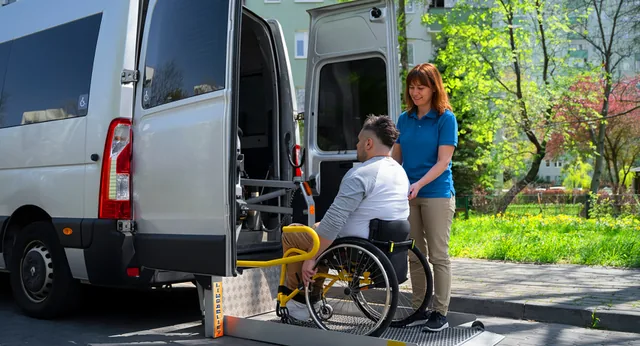
NDIS Travel and Transport Support
Getting to appointments, work, study and community activities across Western Sydney, and a plain account of how NDIS transport funding works.
Vivid Support Network drives and travels with NDIS participants across Western Sydney and Wollondilly, from offices in Glendenning and Silverdale. We also teach travel skills, so a trip can become yours over time.
In short
- Transport money for your own travel sits in the recurring supports budget: $1,784, $2,676 or $3,456 a year, depending on your week.
- When a worker drives you during a support, the kilometres are activity-based transport, claimed from that support's budget, not from your transport money.
- A worker's travel time to reach you is capped at 30 minutes in metro Sydney under the NDIA's current claiming rules.
- The NSW Taxi Transport Subsidy Scheme pays half of each taxi fare, up to $60 a trip, alongside your NDIS funding.
Western Sydney is spread out, and buses between suburbs are often slower than the map suggests. For many people, transport is what makes the rest of a plan usable.
What we do
- Drive you to and from appointments, work, study, day programs and activities.
- Travel with you on the train or bus, where that is the goal.
- Teach you a route in stages, until you can do it on your own.
- Help with mobility aids and with getting in and out of the car safely.
- Stay with you at an appointment, where your plan funds the support.
Our team rosters drivers and support workers every day from our Glendenning office, in the Blacktown council area, and from our Silverdale head office.
Who can get NDIS transport funding?
The NDIA funds transport when your disability means you cannot use public transport without substantial difficulty. That is the test in its guideline on what goes in a plan.
It also looks at what your family, carers and community can reasonably do, and it takes the NSW taxi subsidy into account. It does not fund family members to drive you to everyday commitments.
What are the three transport funding levels?
Transport money for your own travel sits in its own budget, called recurring supports. The NDIA pays it into your account on a regular basis, or you claim it through the portal or the my NDIS app.
| Level | Amount a year | Who it is for |
|---|---|---|
| Level 1: community access | $1,784 | You are not working, studying or at a day program, but want to do more in the community. |
| Level 2: some work or study | $2,676 | You work or study up to 15 hours a week, attend a day program, or take part in social and leisure activities. |
| Level 3: work or study | $3,456 | You work or study, or both, at least 15 hours a week. |
NDIS recurring transport funding levels, per year
Key figure: The NDIA's three transport levels range from $1,784 to $3,456 a year, which is about $34 to $66 a week.
Show the numbers as a table
| Level | Amount a year |
|---|---|
| Level 1: community access | $1,784 |
| Level 2: some work or study | $2,676 |
| Level 3: work or study | $3,456 |
Link to this chartVivid Support Network, November 2026
The amounts are on the NDIA's recurring supports page. Higher amounts are possible in exceptional cases, mostly linked to work, but they need evidence at a plan review.
What does a trip with a support worker cost your plan?
When a worker drives you, three things can be charged: the worker's time, the kilometres, and the worker's travel to reach you. None of them comes out of your recurring transport money.
| What is charged | NDIS maximum | Where it comes from |
|---|---|---|
| The worker's time with you | $73.58 an hour, weekday daytime. Evenings and weekends are higher. | The budget for the support, for example community participation (04_104_0125_6_1) |
| Kilometres while the worker drives you (activity-based transport) | $0.99 a km in a standard car, or $2.76 a km in a modified vehicle or bus | The same budget as the support (04_590_0125_6_1) |
| The worker's travel time to reach you | Up to 30 minutes in metro Sydney, at the support's hourly rate | The same budget as the support |
| The worker's kilometres to reach you | Up to $0.99 a km | The same budget as the support (provider travel, non-labour) |
| Tolls, parking and fares | The actual cost, where agreed | The same budget as the support |
Here is a worked example at the maximums. A two-hour weekday outing with 20 km of driving is $147.16 for the worker's time and $19.80 for the kilometres. That is $166.96 at most, from the budget for the support.
What a two-hour outing with a support worker costs a plan
Key figure: On a two-hour weekday outing with 20 km of driving, 88% of the cost is the worker's time. The kilometres add $19.80, for $166.96 at most.
Total at NDIS maximums: $166.96
- Worker's time $147.16 (88%). 2 hours at $73.58.
- Activity-based transport $19.80 (12%). 20 km at $0.99 in a standard car.
Show the numbers as a table
| Part | Amount | Share |
|---|---|---|
| Worker's time | $147.16 | 88.1% |
| Activity-based transport | $19.80 | 11.9% |
| Total | $166.96 | 100% |
Link to this chartVivid Support Network, November 2026
Outing cost calculator: a support worker driving you
Enter the hours and the kilometres to see what an outing with a support worker can cost your plan at NDIS maximum prices.
How this is worked out: hours are multiplied by $73.58, the weekday daytime maximum for a support worker, and kilometres by the vehicle's NDIS rate. Evenings and weekends cost more, and travel to reach you is extra. The example shown is a two-hour outing with 20 km in a standard car.
Link to this calculatorVivid Support Network, November 2026
Travel back to the office can only be charged from the worker's last visit of the trip, and only if the worker is paid for it. If a worker visits two people on one trip, the travel is split between them.
The NDIA has not yet published its 2026-27 claiming guide, so the travel rules above are still the 2025-26 ones. We write the basis for every charge into your service agreement before the first trip. Our guide to provider travel and kilometre charges explains each rule.
Transport funding and a worker's time are two different things. A plan can fund one without the other, so check both before supports start.
Which budget pays for which trip?
- Your own taxi, rideshare or community transport: recurring transport funding.
- A worker driving you during a support: the budget for that support, usually Core.
- A worker travelling to reach you: the budget for that support.
- Learning to travel on your own: Improved Daily Living, under Capacity Building.
- Changes to a car: Capital supports, after an occupational therapist's assessment.
What transport funding does not cover
It does not pay for a car, running costs or fuel. It does not cover travel unrelated to your supports or goals, or a family member's travel. Where public transport works for you, the NDIA expects you to use it.
How to make the funding go further
- The NSW taxi subsidy. The Taxi Transport Subsidy Scheme pays half of a taxi fare, up to $60 a trip, including wheelchair-accessible taxis. It is not means-tested. Our taxi subsidy guide covers how to apply.
- Gold Opal. With a Pensioner Concession Card, public transport costs no more than $2.50 a day.
- Community transport. Local operators run door-to-door trips for people whose disability limits their travel. Transport for NSW lists them on its operators page.
- Stations with lifts. Rooty Hill and Mount Druitt stations both have lifts, so some trips cost nothing from the plan. Our MLAK key guide covers accessible toilets and facilities on the way.
- Records. If the funding does not cover the travel your week needs, keep a record of trips for a few months and take it to your review.
Transport around Blacktown and Mount Druitt
Most of our transport work is in the Blacktown council area, where our Glendenning office sits between Rooty Hill and Doonside. A few local facts shape how trips are planned:
- Hospitals. Blacktown Hospital and Mount Druitt Hospital are the two public hospitals. Bus 721 loops from Blacktown station to Blacktown Hospital.
- Stations. Rooty Hill and Mount Druitt stations both have lifts, and the T1 Western line runs to Parramatta and the city.
- Cars. In Doonside 10.9% of households have no car, and in Blacktown 9.7%, against 9.0% across NSW at the 2021 Census.
- Community transport. Transport for NSW lists Active Care Network for Blacktown, Penrith and the Blue Mountains.
Because our workers start close by, the travel time charged to reach you is usually well under the 30-minute cap. Our guide to getting around Blacktown and Mount Druitt has the bus routes, a suburb-by-suburb table of car ownership and the stations with lifts.
Travel training
Where travelling on your own is the goal, we work the route in stages. First we travel with you the whole way. Then we meet you at the other end, then we phone, and then you go alone. You set the pace.
Public transport training is funded as Improved Daily Living, item 15_037, up to $73.58 an hour on a weekday. A support worker can deliver it.
How to start
- Call us on 1300 410 507 or make a referral. Tell us where you need to go, how often, and what help you need on the way.
- We check which budget in your plan will pay: Core for a worker's time and driving, or your recurring transport funding for your own trips.
- We confirm the vehicle suits any wheelchair or mobility aid you use.
- We write the hourly rate, the travel and kilometre charges into your service agreement before the first trip.
- The same regular workers drive you each week where we can, so you know who is coming.
We work with NDIA-managed, plan-managed and self-managed participants.
Where we provide transport
Every day across the Blacktown council area, including Mount Druitt, Rooty Hill, Glendenning, Doonside, Plumpton and Blacktown. From our Silverdale office we cover Silverdale, Warragamba and the villages around them.
Where this information comes from
Every figure and rule on this page was checked against one of these on 10 November 2026. The NDIS changes; if something here is out of date, tell us and we will correct it.
- NDIS: what are recurring supports (transport levels)
- NDIS: pricing arrangements and the Pricing Schedule 2026-27
- NDIS: Pricing Arrangements and Price Limits 2025-26 (travel and transport claiming rules)
- NDIS: guideline on including specific types of supports in plans (transport)
- Transport for NSW: Taxi Transport Subsidy Scheme
- Transport for NSW: senior and pensioner Opal fares
- Transport for NSW: community transport
Questions about transport
How much NDIS transport funding will I get?
It depends on what you do each week. The NDIA publishes three levels of recurring transport funding: $1,784 a year for community access, $2,676 if you work or study up to 15 hours a week, and $3,456 if you work or study 15 hours or more, or are looking for work. Check your plan for your level.
Can an NDIS support worker charge for travel time and kilometres?
Yes, within limits. Under the NDIA's current rules, travel time to reach you can be claimed for up to 30 minutes in Sydney, and the worker's kilometres at up to $0.99 a km. The basis must be agreed in your service agreement before supports start.
What is activity-based transport?
It is the cost of a worker driving you during a support, for example to an activity. It is claimed per kilometre, up to $0.99 a km in a standard car or $2.76 in a modified vehicle, from the budget for that support.
Is provider travel taken out of my transport funding?
No. Provider travel is charged against the budget for the support itself. Your recurring transport funding is for your own travel.
Can I use the NSW taxi subsidy as well?
Yes. The Taxi Transport Subsidy Scheme is a NSW scheme, separate from the NDIS. If you are eligible it pays half of each taxi fare, up to $60 a trip, so your transport funding goes further.
Is NDIS transport available in Blacktown and Mount Druitt?
Yes. Our Glendenning office is in the Blacktown council area, and our team rosters drivers and support workers there every day, including Mount Druitt, Rooty Hill, Doonside and Blacktown.
Will the NDIS pay for Uber or a taxi?
Yes, from your recurring transport funding, which is paid to you and can be used for taxis and rideshare. The NSW taxi subsidy also pays half of each taxi fare, up to $60 a trip, but it does not cover rideshare.
Can my support worker charge for the drive back to their office?
Only from the worker's last visit of the trip, and only if the provider pays the worker for that travel. It must be agreed in your service agreement first.
Can you take a wheelchair?
It depends on the chair and the vehicle. Tell us what you use and our team confirms vehicle suitability before anything is booked.
Can transport be part of supported independent living?
Yes. Getting to appointments and activities is part of the support for people living in the Glendenning home.
What if I just need occasional lifts?
That is fine. Regular weekly transport and the occasional appointment are both normal.
Make a referral or ask about a placement
Tell us the supports the plan funds and when they need to start. We respond the same business day.