

The NSW Taxi Subsidy and NDIS Transport: Using Both
How the Taxi Transport Subsidy Scheme works, who can apply, how the smartcard works, and how it fits with NDIS transport funding.
 By Anupa Bhetwal, Registered Nurse · Funding · 8 min read · last checked 10 November 2026
In short
- The NSW Taxi Transport Subsidy Scheme (TTSS) pays half of a taxi fare, up to $60 a trip.
- It is for people with a severe, permanent disability. It is not means-tested.
- You pay with a TTSS Smartcard. Paper dockets are now only a backup.
- Being on the NDIS does not stop you using the TTSS.
- The NDIA takes the subsidy into account when it sets transport funding.
For many people in Western Sydney, a taxi is the only practical way to some appointments. The NSW taxi subsidy halves the cost, and it works alongside NDIS transport funding. This guide covers who can apply, how to apply, and how to make both go further.
What the subsidy pays
The Taxi Transport Subsidy Scheme covers half of a taxi fare, up to $60 a trip. You pay the rest. It includes wheelchair-accessible taxis.
- A $40 fare: the subsidy pays $20 and you pay $20.
- A $150 fare: the subsidy pays the $60 cap and you pay $90.
There is no set limit on the number of trips. You can make one claim per trip, and Transport for NSW may check use that looks unusually high.
Who can apply
All of these must be true:
- you are a permanent resident who usually lives in NSW;
- you are over school age (Transport for NSW says preschool children are not eligible, so call 131 500 to check for a school-age child);
- you are not in a similar scheme in another state or territory;
- you have a severe, permanent disability in one of the five categories below.
The scheme is not means-tested. A pension does not make you eligible on its own. Service NSW also says that if you are having treatment expected to improve your condition, you are not eligible yet.
The five disability categories
These are summarised from Transport for NSW. Your doctor confirms which one applies.
- Mobility. You need a wheelchair, or can only walk inside your home, or walk less than 20 metres without rest and always need an aid or another person, or cannot manage three steps, or cannot use both arms.
- Vision. Total loss of sight, very low vision in both eyes, or a severely narrowed field of vision.
- Epilepsy. Severe and uncontrolled, with more than 12 episodes a year. Approval is reviewed every two years.
- Intellectual or cognitive. You cannot use public transport on your own, for example because you cannot remember the destination or manage fares.
- Speech or hearing. A severe, permanent difficulty, so you always need another person to communicate.
How to apply, step by step
- Get the application form online, or call 131 500 to have one posted.
- Fill in Part A yourself, or ask an authorised representative to help.
- Ask your GP or specialist to complete Parts B and C. Attach a recent specialist report if you have one.
- Add a photo. Transport for NSW says applications without a photo are declined.
- Upload the form online or post it. Service NSW explains the steps on its TTSS page.
An independent medical assessor reviews each application. Transport for NSW says applications are processed within 30 business days.
Paying with the TTSS Smartcard
The scheme now uses a TTSS Smartcard with your photo on it. You tap it on the taxi's payment terminal, the subsidy comes off the fare, and you pay the rest. The card is valid for three years.
Paper dockets are now a backup for taxis that cannot take the card. Blue docket books replaced the old pink ones, which stopped being accepted after 31 January 2026.
The subsidy works in taxis only. It cannot be used for rideshare such as Uber, or for hire cars.
Wheelchair-accessible taxis
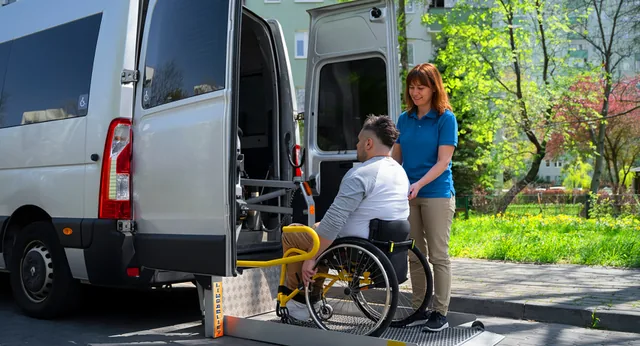
If you always need a wheelchair, your card allows travel in a wheelchair-accessible taxi. This needs a mobility check as part of your application.
In Sydney you can book on 13 90 00. Transport for NSW says booked fares for TTSS members stay regulated.
How it fits with NDIS transport funding
Being on the NDIS does not change how you use the TTSS. NDIS transport funding is paid to you through the recurring supports budget: $1,784, $2,676 or $3,456 a year, depending on your week.
The NDIA's guideline says the funding it provides "will take into account any relevant taxi subsidy schemes". So apply for the subsidy first, and tell the NDIA you have it at your plan meeting.
Your NDIS transport money can then pay the half of each fare that you owe. It can also pay for rideshare, which the subsidy does not cover.
How far a transport budget goes
Take Level 1 funding of $1,784 a year, which is about $34 a week. Say a return taxi trip to your appointment costs $40.
- Without the subsidy, the budget covers about 44 return trips a year.
- With the subsidy, you pay $20 a trip, so it covers about 89.
That roughly doubles the trips your plan pays for.
Return taxi trips a Level 1 transport budget pays for in a year
Key figure: The NSW taxi subsidy roughly doubles the taxi trips a Level 1 NDIS transport budget pays for, from about 44 to about 89 return trips a year.
Show the numbers as a table
| Scenario | Return trips a year |
|---|---|
| Without the taxi subsidy | 44 trips |
| With the taxi subsidy | 89 trips |
Link to this chartVivid Support Network, November 2026
Taxi subsidy calculator
Enter a taxi fare to see what the NSW taxi subsidy pays, what you pay, and how many trips your NDIS transport level covers.
How this is worked out: the Taxi Transport Subsidy Scheme pays half the fare, up to $60 a trip. Trips a year are your transport level divided by what you pay per trip. The example shown is a $40 fare on Level 1.
Link to this calculatorVivid Support Network, November 2026
If a driver refuses the subsidy
Drivers must accept the scheme. In March 2026 the NSW Government announced fines of $3,000 for drivers who refuse a TTSS smartcard or docket. If it happens, note the taxi number and time, and report it to Transport for NSW.
Travelling interstate
The smartcard works in NSW only. For trips interstate, order interstate dockets from Transport for NSW, and allow two to three weeks.
Other help with getting around
- Gold Opal. With a Pensioner Concession Card, trains and buses cost no more than $2.50 a day.
- Community transport. Local operators run door-to-door trips for people whose disability limits their travel. Find them on the Transport for NSW operators page.
- A support worker. If you need help during the trip, a worker can drive or travel with you. That is charged to the support's budget, not your transport money. Our transport page explains the costs, and our guide to provider travel charges sets out the rules.
Questions about the taxi subsidy
How do I apply for the taxi subsidy in NSW?
Get the TTSS form online or by calling 131 500. You complete Part A, your GP or specialist completes Parts B and C, and you add a photo. Then upload it or post it. Transport for NSW says applications are processed within 30 business days.
Who is eligible for the NSW taxi subsidy?
NSW residents over school age with a severe, permanent disability in one of five categories: mobility, vision, epilepsy, intellectual or cognitive, or speech and hearing. It is not means-tested.
Are pensioners entitled to taxi vouchers?
Not on a pension alone. The TTSS is based on disability, not income. Pensioners can get Gold Opal, which caps public transport at $2.50 a day.
Can I claim taxi fares on the NDIS?
Yes. NDIS transport funding is paid to you through the recurring supports budget and can be used for taxis, including the half of the fare the subsidy does not cover.
Will the NDIS pay for Uber?
Yes. NDIS recurring transport funding can be used for rideshare. The NSW taxi subsidy cannot, because it works in taxis only.
Is there a limit on how many subsidised trips I can take?
There is no set limit on trips. The cap is $60 a trip, with one claim per trip, and Transport for NSW may check use that looks unusually high.
Does the subsidy cover wheelchair-accessible taxis?
Yes. If you always need a wheelchair, your smartcard allows travel in a wheelchair-accessible taxi, and booked fares stay regulated.
Make a referral or ask about a placement
Tell us the supports the plan funds and when they need to start. We respond the same business day.